Monday, October 31, 2011

Random Research: The Loebner Prize

Subtitle of this post: Sharing The Only Worthwhile Thing I Learnt in Philosophy As a Celebration of Never Having to Do It Again.

Commencing explanatory preface.

Explanatory preface loaded. Launching...

So, today was the day of the first of the end-of-year exams for my first year in university. Incidentally, this first exam was also the last philosophy exam I will ever have to take, mostly because I'm a science student and my curiosity in arts has been KO'd with this one-unit (course for you Americans [and Brits? I have no idea] out there) venture, but also because I have discovered that studying philosophy sucks. I like thinking and I like telling people what I think and how I think and why I think how I think, but studying and trying to explain what dusty old men might perhaps think in difficult, entirely hypothetical terms just doesn't do it for me. Science can be hard, but at least it limits itself to this world in entirely testable terms instead of some hypothetical universe where you should be prepared for any amount of hypothetically crazy shit happening. To summarise my experience with philosophy:
Just as a side-note, I don't mean disrespect for anyone who studies or enjoys philosophy. If you're doing it, getting it and enjoying it, you're probably cleverer than me anyway, and thus deserve my resentment.

The one thing that I did like about the course that I was studying were the topics we were studying: we studied the possibility of time-travel, whether machines can think or not and such sci-fi topics. A particular favourite of mine was this possibility of machines thinking, and I'd like to share a tidbit of it with you.

You see, in 1950, a guy called Alan Turing declared (by publishing a paper) that he thought that asking "can machines think?" is too much of an ambiguous question. In his opinion, if we were ever to reach clarity on this question, we would be better off with formulating some sort of way to test the ability to think instead of just postulating about it abstractly. The ability to test for thought relies on a functionalist principle, which assumes that the ability to think doesn't rely on having a brain similar to that of a human being; further, that thinking is simply information processing. I'm not entirely sure how persuasive or true these assumptions are -- like I said, this unit didn't really set me on fire (if that even is a valid metaphor) -- but the fact that I resent the general human attitude that we're so much more special than everything else makes me inclined to agree.

In that 1950 paper, Computing Machinery and Intelligence, Turing proposed such a test. In this test, a judge would have a written discussion with one machine and one human being without indication of which was which. Both participants would attempt to convince the judge that they are the human being. Then, after a 5-minute discussion, the judge would decide which of the participants is a human being: and if the computer manages to fool the judge over 50% of the time (in which case it is indistinguishable from the human being), it can be said to have passed the Turing test.

It sounds mighty interesting, doesn't it? If you're like me, you'd give anything to be a fly on the wall during such a discussion. The wonderful thing is that we can.

The Loebner prize is an annual competition that, as I understand, accepts applications from anyone and everyone who wants to build a program that can behave like a human and answer any possible questions from a human in an intelligible manner. As I understand it, no computer has "passed" the Turing test as of yet, per se, but there is a cash prize involved every year for the program with the highest overall rank. I don't have the slightest understanding about programming, but if you're interested in seeing what it takes, click here.

For me, the fascination is in looking over the competition transcripts. My personal favourite is "Do-Much-More", with this fabulous quote:
Judge-3:What do you do when you're not doing the Loebner prize? 
Do-Much-More:Oh, I do much more than I intended to do at first. I got more interested in the job as I went along.
Judge-3:Is that difficult? 
Do-Much-More:No, it isn't at all difficult. It is as peaceful as a platypus playing with a potato pudding.
Of course, I also immensely enjoy chatting to Cleverbot. If you haven't tried it yet, be sure to -- it's a whole lot of fun, even if you have to make a little bit of an effort to keep a coherent discussion going. If you've become fascinated by chatbots, go to the Loebner prize home page, as I'll list in my sources in just a moment -- you can find past transcripts and other interesting stuff there.

Hope you enjoy yourself in the wonderful world of AI.

Sources
http://www.worldsbestchatbot.com (quote found here)
http://www.turing.org.uk/turing/
http://en.wikipedia.org/wiki/Loebner_Prize
http://cleverbot.com/
http://www.loebner.net/Prizef/loebner-prize.html

Additional, technical endnote: This post is riddled with links. Unfortunately, (I think) due to my theme, they don't like to show up in a different font unless you actually mouse over them (this has been the case with a few of my posts. I'm afraid you've missed out on a whole lot of awesome links -- mostly to wikipedia). I am hopeless at figuring such things out, and a brief search of my options didn't help me much. If you know how to make links visible without having to change my theme, please shoot me a comment and let me know.

Friday, October 28, 2011

Bringing out the flamethrowers

A few posts ago, I posted about how I was going to try the Snowflake method to plan this year's NaNoWriMo novel, talking about how my 2009 novel faltered and then died because of my poor planning and inability to keep the strings of the story in my head.

Well, since then, I've actually gotten past step 1. In fact, I've gotten as far as step 3!

I have also discovered that I freaking hate it.
Relevant to my hate toward the Snowflake method. Incidentally, I actually made this one myself. In paint. The dinosaurs in Google images were way too cute to adequately express my hatred.
The Snowflake model has no soul. I guess that if you already have an idea that is fairly articulate inside your head but don't have it down on paper yet, the Snowflake model might be some merit to it. With this, I mean that it might be a good organisational tool to get all of your ideas down in a format that will ultimately help you get your work down in an intelligible manner. But as a tool for someone who only has the very raw bones of an idea in their head, such as "two vampires, a werewolf and a shapeshifter go on a road trip" -- it probably doesn't take a genius to figure out that that was my idea -- I would definitely go as far as to say that, instead of being helpful, the Snowflake method could very well kill that idea.

You see, the Snowflake method is a method of production. It's a method of making your novel publishable: of writing a synopsis and then writing the novel to suit that synopsis. It is meant to lay your entire novel down before you actually write it, in a manner that is so clinical that makes me remember the faint chemical smell of hospital corridors. I've sat here for a few minutes, trying to get it into words why exactly I get this feeling from trying to slog through step 3 of the method, but I don't think anything I can produce right now would be very convincing. I thought about complaining about the fact that I am supposed to figure out the motives for my characters before I have actually formulated personalities for them, but in the overall sense of the central story of the novel, I guess asking about the motivation and conflict and epiphany of your characters makes sense.

But that's exactly the problem. How am I -- in fact, why am I -- supposed to know the inner workings of my novel before I've written it? I guess this sounds childish, and this may be only my own opinion, but I think that every story has a soul, and that every story teaches you something about yourself and the way you view the world. Every story evolves as you write it, and often takes you by surprise. For example, in 2009, it took me about 15 chapters to realise that one of my central characters was gay. Only a fool would plot their story out from the get-go, thinking that it won't change.

Saying that, I want to clarify that I'm in no way implying that everyone who has ever used the Snowflake model is a fool. Perhaps others like having the bones of their story down before beginning the actual creative process. I also concede that I may be using it wrong, and that perhaps I should return to it after I have a firmer grasp of what my novel is actually going to be about. But right now, it's just the wrong thing for me: I feel no creative flair when working on it, but just like I'm toiling endlessly at some sort of machinery with nothing to show for it. The point of planning, for me, at least for WriMo, is to lay down a general outline of the story in such a manner that I'm not completely at the mercy of my creative juices, especially on days when they've completely run dry. The point of planning is to inspire, and to make me excited about the scenes I've just described. The point of planning is to make me want to tell my story.

The Snowflake model is not doing it for me. I'm not sure if any planning model will work with this particular novel. I'm not sure I was ever any good at planning. I'm not sure that this story is even worth telling. But I guess I'll try to keep at it, even simmering at the back of my brain, and see if I can salvage at least a bit of what made me excited about it before.

Hope the rest of you have more luck at this than I have had.

Tuesday, October 25, 2011

Random Research: Caffeine

Today was my first second (I can even procrastinate finishing blogposts!) day of study for exams. It was the first second of many, many days, leading up to the 16th of November, the day of my last exam. Between now and then, I will hardly have a day's rest, not only because of exams and cramming (as outlined a few posts previously), but also because November is already knocking on my door, and my NaNoWriMo novel is SO not ready to be written yet! I mean, I don't even have character names yet! I now have names for my most important characters, but the whole project is still more of a plothole than anything.

You guys know what this means, right? It means that, in order to keep my head above the water, I'm going to need LOTS AND LOTS OF CAFFEINE. Everyone who's ever done NaNoWriMo (or gone to university in general, I'm guessing) is very, very familiar with this solution. That, and sugar, but I'd like to focus on caffeine for now. And because for some reason, I seem to get the best ideas when I'm supposed to be doing something else, like studying for my philosophy exam -- actually, specifically when studying for my philosophy exam, because I'd rather be doing about a gazillion things than studying for it -- I decided that it was finally time to satisfy my curiosity about caffeine. And then, figuring that you guys are probably either also nerds or geeks and/or doing NaNo and/or going to university, I thought I'd share.


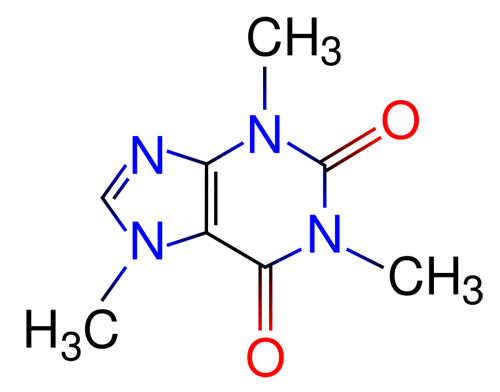
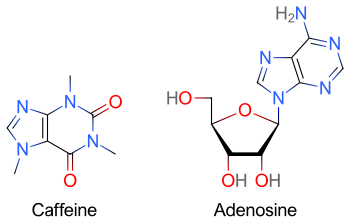
 Caffeine, or, between friends, 3,7-dihydro-1,3,4-trimethyl-1Hpurine-2,6-dione, is a psychoactive drug, meaning that it mainly affects your central nervous system and through that, your brain, altering your behaviour and state of mind. Apart from that ridiculously long IUPAC name, doesn't sound like a whole lot of new information, does it? The interesting bit of information follows: apparently, caffeine is able to do this to our brains, because it is very similar to a chemical that is already present in our bodies: adenosine.

Adenosine accumulates in your brain after long periods of concentration or alertness, and that is interpreted in our brain as a signal to rest or sleep in order to give your poor, hard-worked neurons some time to relax. But no, that really important thing is on tomorrow, you can't afford to lose any time on pesky rest right now! So you go and make yourself a biiiiig cup of coffee, the caffeine molecules swimming around in your cup, and, before long, in your brain, blocking the receptors that usually detect adenosine, keeping you alert and focused for juuust a little bit longer.

Sounds like a pretty sweet deal, doesn't it? Fortunately, too, caffeine doesn't appear to have that many adverse side-effects: though it is claimed to be a diuretic, thereby leading to dehydration, the generally accepted view is that this is not true, and that any such effect caused by caffeine is similar to that of water. Previously, it had also been thought to increase blood pressure, but recent studies have shown no such connection. There's a whole list of risks and benefits of caffeine listed on wikipedia, if you're interested -- I only glanced at the list, but I didn't see anything there that was blatantly contradicted by the rest of my research; still, take it with a grain of salt. I guess the fact that it appears relatively harmless makes sense: I wouldn't think that anything ultimately harmful to humans could be used as widely as caffeine is, what with the knowledge we have of biochemistry today.

So, the only thing you really have to worry about in your reckless coffee consumption is addiction. Like any other drug, caffeine is addictive, and, when used extensively will eventually cause withdrawal symptoms like headaches, muscle pain, irritation, and so on and so forth. One site I visited also claimed that caffeine consumption can turn into a vicious cycle: though its effects diminish over time, as with alcohol, there will be a measure left in your body, and that might disrupt your deep sleep pattern, leading to restless sleep, which, then, leads to more excessive caffeine intake.

That's all I've got for now, folks! Hope none of you get caught in the vicious caffeine cycle in the vicious month that is called November (I know I'm about six days off the start of November, but it's appropriate, ok?); and if you are, well, at least it's delicious, delicious coffee, right?


Sources:
http://www.overcaffeinated.org/
http://www.rsc.org/chemistryworld/podcast/CIIEcompounds/transcripts/caffeine.asp?playpodcastlinkuri=%2Fchemistryworld%2Fpodcast%2FCIIEcompound.asp%3Fcompound%3DCaffeine
http://en.wikipedia.org/wiki/Caffeine
I also mercilessly stole the pictures off google images. If you own any of these images and would like them removed, please notify me in a comment, and I will take them down.

Sunday, October 23, 2011

The story of how I fail a lot

Hark, listen! For I shall tell you a story of how I really suck at making decisions and how that lead me to a decision that I will not, fingers crossed, regret.

At my university, they should offer a course (or unit, as we say in Australia *aussiepride!*) about picking courses, and then make it compulsory for me to take it. I've been at my uni for a whole two semesters now, and one thing I've learnt is that I really, really suck at picking units.

You see, at the end of last year, when I finished high school, I discovered that I had done very, very well on my exams and my grades were very, very good. I also knew that the course I had planned to apply for didn't actually require grades quite that magnificent. So, in a fit of pride, I decided that I should put those grades to good use and apply for a double degree instead. The specific double degree I finally decided on was a science/biomedical sciences degree. The smartest of you will probably notice how "biomedical sciences" has the phrase "bio" in it, which is, in all likelihood, referring to biology. Even though I had it on paper that I am really smart (or just a massive nerd), this fact somehow failed to register with me. See, I knew that I hated biology. I knew this from the get-go. And still, I thought it was a good idea to devote half of my degree to it.

Extremely surprisingly, I hated both (one semester consists of four units at my university) of my biomed units, and at the end of semester one, I proceeded to transfer to the science degree that I wanted to apply for in the first place.

Then it came time to pick units for semester 2. I was extremely excited, because since I was now doing a single degree, I had room for electives -- I wouldn't only have to confine myself to core units as double degree students are forced to, but I could actually do something fun as well! Further, I could do a unit outside my own faculty; I could pick some really interesting arts unit to balance with my three science units! I perused the multitude of units they offered in the arts faculty, and finally settled on a philosophy unit.

Considering the tone of this post, can you guess what the problem was here? Yep, I actually really hate philosophy. Why? Because I don't usually even think in a coherent manner -- I'm much more a touchy-feely type person than an evaluative, rational person in my life philosophies. As with biology, I knew this beforehand; for some reason, the unit description just got to me and I thought that I would somehow magically begin liking it.

For next year, then, I've finally given up the notion that I'm any good at picking units. Instead of failing at picking electives, I'm going to focus all my energy and attention on something I know I love: I've decided that I'm going to do a double major (72 points instead of 48 points; each unit is 6 points, don't even know why) in chemistry. I know that it's going to kill me a little, but if last year (i.e. my last year at high school) is any indication of anything, it's indication of the fact that I'm not afraid of doing work.

That, and I'm a huge nerd, and I take pride in doing lots of nerdy things.

Wish me luck!


EDIT 23/10 18:45: Yeah, I only now realised how badly I had screwed that title up. I guess you could've interpreted that as some sort of a pun as to how badly I fail? Alas, no, it was an actual (to borrow Neil Gaiman's wonderful expression) #silbenawebfail. Derp.

Saturday, October 22, 2011

Review: The (incomplete) Kingkiller Chronicle

If you've visited this site every now and then, you would've probably realised that my GoodReads profile gadget thing is sitting right about ----> there, but further down (depending, of course, where this post is when you get to it). If you've been paying even more attention than just to go "oh, I see" and then glazed over thinking about penguins (wait, everyone doesn't do that?), then you would have noticed that by now, there have been two different book covers in that section there, representing the two books I've read since I started this blog. For those of you who aren't freakish stalkers (not that I don't love all my freakish stalkers), those two books were by Patrick Rothfuss, and were called The Name of the Wind and The Wise Man's Fear, respectively. This morning, I finished reading The Wise Man's Fear, and I think I promised to write something about these two books once I had finished, so here goes nothing.

Actually, before I start, I should probably warn you that I have no idea whatsoever how to do book reviews, or even book overviews, for that matter. While I stall and try to think about how to go about all of this, feel free to go update twitter to talk about the crazy blogger girl who doesn't plan her posts and just spews random nonsense.

Back? Alright, let's get this show on the road.

Patrick Rothfuss' Kingkiller Chronicle (of which The Name of the Wind is the first, and The Wise Man's Fear is the second part), as I understand it, is intended to be a trilogy, each novel of which represents a single day, during which Kvothe (pronounced 'quothe', as the author reminds you every chance he gets) the protagonist of the novel, tells his own story. The function of the story within a story is twofold -- as the writing style is extremely intense, full of twists and turns and surprises, victories and downfalls, it gives the reader a chance to breathe every now and then, reminding us of the fact that since Kvothe is still alive, nothing that bad could really have happened. But at the same time, as Kvothe reminds us during almost each of these breaks in the story, the situation he has landed in by the end of his story is far from ideal, and that we really shouldn't except the best -- so there's a definite sense of foreboding going on all the time. It's very captivating, even if the sentiment of the interludes can get a little repetitively depressing at times, especially in the second book.

The comparison between the two books is actually quite different to the comparison of any other two books in the same series. I usually like the first book more, because it is always, always far more polished, and contains the introduction to the story and the world, which is always my favourite bit in every series I read. The first book is spent introducing Kvothe and his background, whereas the second book concentrates more on his adventures and experiences in the world. The fact that he travels so much allowed the second book to preserve that sort of introductory feeling of the first book, which I was pleasantly surprised by. In many ways, the story in the second book may be richer in its surroundings, because there need not be such emphasis on the character himself, since he has been thoroughly introduced in the first book. I was especially impressed by the dual simplicity and intricacy of the cultures Rothfuss introduces in the second book. Saying that they were both simple and intricate sounds a little paradoxical, I know, but what I mean is that the cultural quirks at least appeared deep and well thought-out, but were still very easy to follow.

What I am not impressed with is Kvothe's age. By the end of the second book, he is around 17, if I remember correctly -- but throughout the entire series, there has been no indication of him being this young, except for the author's intermittent statements that Kvothe does not know his way around women. I partially understand Rothfuss' need to have a young character as the protagonist (to do with his motivations; avid fantasy readers can guess this), but... It's just annoyingly unrealistic. For those of you whose brains have gone off, screaming "MARY SUE MARY SUE MARY SUE", I should issue this warning: Kvothe is pretty much the epitome of a Mary Sue character. However, I can also say this: I hate Mary Sues, but Kvothe's exceptional skill in absolutely everything didn't bother me. I'm not exactly sure why: I guess he has enough human awkwardness (though I do admit that that diminished to almost nothing at the end of the second book; this is one of the things I didn't like about it) to justify his exceptional skill at most things.

Overall, Rothfuss is both an amazing writer in a technical sense -- he has this fondness for subtle suggestion, which always rings true for me -- and a great storyteller. The praise on The Name of the Wind suggests that I shelve mine next to Lord of the Rings, and while I don't think that it's exactly comparable to LOTR -- it's very hard to be -- it definitely wasn't much of a step down to go from Tolkien to Rothfuss. If you love fantasy, this trilogy is a must-read; if you don't, you could still enjoy it, if you just gave it a chance. Rothfuss makes his world extremely accessible, and the story is oftentimes unpredictable, full of secrets and foreshadowing and exciting characters.

I can't wait for the third book in this series, I really can't.

Phew. There. How did I go? Did I inspire you to pick up the book? Did anything that I said make sense? Give me some feedback!

Monday, October 17, 2011

Mission: Cramming

I think they (ambiguous, perhaps referring to the government or medical authority or anyone who is ever in contact with young people of the right status and age) should announce a valid medical condition called University Syndrome. The symptoms of this terrible illness include sleeplessness, excessive caffeine consumption, general bleariness, bloodshot eyes, gradual lightening of skin pigment (provided this is applicable), tension headaches due to soreness in the back, shoulders and neck, an apparent inability to focus and so on and so forth. It also includes social behaviour such as only coming out during the night (also applicable for vampires, for which a myriad of the other also apply; take care to watch for fangs), only being able to talk about studying or the things you were doing while you were supposed to be studying, a habit of locking oneself into a room with a pile of books, and a diet steadily declining in healthiness, though it never was very good to begin with.

The time has come for the end of semester, and shortly, the exam period will commence. Before that, I'll still somehow have to manage to cram a semester's worth of study into a week -- for each of my units respectively (in that, I'm lucky: some people have to cram ALL their units into one week). In all fairness, I don't exactly hate doing it -- I'm nerdy enough and like what I'm learning enough to like having the closure of running through everything I've learnt at the end of semester and bringing it all together to form one big picture. At the same time, I'd much rather be playing videogames, watching movies and tv-series, continuing on my Epic Reading Quest and planning my novel.

Yes, the new novel that I'm planning for NaNoWriMo this year. I mentioned it a few posts or so back, and the progress I've had on it since I mentioned it has been exactly zero. Well, technically, if you count the amount of brainstorming I've done on public transport to and from university (excluding the times I've been reading The Wise Man's Fear) and the amount of ideas I've stored at the back of my brain, the progress I've made on it on a scale of a hundred is maybe one. I had really been hoping to get a full outline down for this one before beginning it, but it doesn't appear likely that I'll be able to do it. Still, I'm not too worried -- I'm excited about my idea, and that means more than any detailed outlines I could ever produce. I'll tell you more about my novel at a slightly later date, when I'm not completely bleary and confused by study, and actually have something more tangible than just the bare bones of it down. My characters have personalities, but not even names, yet!

Here concludes my shabby, brief update on what I've been doing in the past week or so. I don't know if I mentioned this before, but if you follow me on Goodreads (I think there's a link somewhere on the sidelines), you'll know I finished The Name of the Wind some time ago. I'm now rapidly pawing my way through The Wise Man's Fear -- in fact, it's so damn addictive it is actually one of the principle reasons I haven't been sleeping well at all for the past few weeks. Here's to hoping that I finish it soon so that I can get a good night's sleep for once. Also, when I do finish it, I plan on posting a little review-type thing on the two parts of the trilogy that have currently been published, so you've got that to look forward to, alongside the details about my novel. There are also some other marvelously geeky plans I have for this summer, but they might fall through, so I'm not going to talk about them before I'm 100% sure it's going to happen; but if it does, I promise that the first thing I do is to come online and talk about all of that.

So, providing that my books don't somehow swallow me whole (a real, tangible threat when you've got this many books lying around), you should look forward to hearing of me very, very soon!

Thursday, October 6, 2011

The woes of nerdhood

In my honest opinion, one of the most difficult things about being a nerd is that one time in a hundred  -- assuming, of course,  that you're either brilliant or know your stuff well enough to keep your mouth shut when you know you don't know your stuff -- when you're actually wrong.

To be honest, I'm possibly not the best person to be talking about this, because I am a horrible perfectionist with a bit of an obsession for being organised -- and with that, comes the need to forever be prepared. I'm always careful not to stick my nose into an argument I don't feel sure about. You hardly ever see me discussing things that I don't feel I'm "entitled' to discuss, because I don't feel like I've got enough knowledge about a certain subject.

Still, I firmly believe that no-one likes being wrong. It's like the jarring note when someone scrapes their nails on a blackboard, or a fork against a plate. For some people, it might be weaker and they might be able to shrug it off, but for most nerds, for whom knowing things would (I imagine) be a matter of pride, I'd think that the jar would be stronger than that. Sure, maybe there are some who delight on being corrected because they can now use the situation as a learning opportunity, but I'm relatively certain that anyone who has ever been relatively certain of themselves will display at least a measure of dismay when contradicted and/or corrected on their subject of surety.

That, and those who bother to look into things and are knowledgeable enough to know what they are not knowledgeable in will probably not be wrong on a regular basis, and will be even further dismayed by the unfamiliarity of the feeling. Thus, the nerdfolk would be far more susceptible to the plague of discomfort and metaphorical bristling at the thought (and experience) of being wrong.

Or perhaps I'm trying to soothe the sting of my own pettiness by drawing sweeping conclusions. I wouldn't hold that against me: we're just human beans here, after all.

And I really hate being wrong, you know.