Wednesday, July 17, 2013

Guide on How To University

When you're in high school, your teachers will be very clear on one thing: if you don't have your future planned from the moment you pick your subjects at the beginning of your last year of high school, you may as well kiss your bright future goodbye. For some reason, it seems to be every school teacher's life's mission to convince you of the fact that your life's destiny will be determined for you based on the decisions you make from the age of 16 onward.


I don't know about you, but at the age of 16, I could barely decide what I wanted to eat, (I have since figured it out -- it's probably pizza) let alone what I wanted to do for the rest of my life. Thankfully, I have a family member who spent 30 years of his life doing one thing and then abruptly decided to do pretty much exactly the opposite, so I never whole-heartedly believed in this whole myth. But for those who did prescribe to the belief that the choice of their high school subjects which would lead to a narrowed field of university courses to choose from which would then lead further into a career they would be stuck in for the rest of their lives these decisions must have been truly terrifying.

Me? I have made a number of choices during the course of my university life, all of which have honestly reminded me of the fact that I am terrible at making decisions. Since my life's story makes therefore for great comedy, hell, it'd be a crime of me not to share! So here, have a timeline, starting from my last three years of high school.

How Silbena ended up where she is now

Third last year of high school
Silbena decides on a hodgepodge of subjects for the last two years of high school based on previous experience, picking subjects she likes and has previously been good at. She has no clue about what she wants to do with her life.

Second last year of high school
Silbena drops legal studies because fuck that noise.
An accurate depiction of Silbena's feelings toward legal studies


Third last year of high school
Beginning of the year - Silbena is absolutely convinced that she is going to become a Creative Person when she grows up. She is debating university courses like journalism and creative writing.
I imagine this is what creativity looks like

Halfway through the year - Silbena has an epiphany and decides to study science instead.

I imagine this is what epiphanies look like

Before final exams - After looking into several universities, Silbena decides on Monash University due to the freedom they give to their students to choose their own units without a prescribed core structure of a course. She is so adamant on being accepted to this university she does not even enter other universities into her preferences.

On release of results - Silbena finds out she has done much better than anticipated and hastily changes her mind to do a double degree in science and biomedical sciences, because she feels like she would be "wasting" her good grades otherwise.

First year of university
Beginning of the year - Silbena enrols in her double degree, gleeful and excited. She also gleefully falls into the trap of spending way too much money on textbooks she basically doesn't need anyway. She never buys textbooks again.
Don't buy the textbook until your lecturer starts assigning practice problems from it, and even then wait to see whether you get inundated in mandatory assignments first

Halfway through first semester - Silbena suddenly remembers that the last time she did biology was in year 9 AND she never liked it then either. Why the hell did she choose to do biomedical sciences again?
Nope, biology didn't get any more enjoyable in the time you didn't do it
End of first semester - Silbena switches courses faster than she can switch pants and drops the hell out of biomedical sciences to study simply science instead. She gets excited because now she can actually choose some electives for second semester that she wouldn't have had time for in her double degree. She chooses philosophy, because hey, thinking is fun?

Halfway through second semester - Silbena finds out that philosophy is the worst thing on the planet and begins to suspect that she really shouldn't be allowed to make her own life choices.

End of second semester - Due to her excellent grades, Silbena receives a letter from the science faculty asking her to enrol in a course that will allow her to do honours at the end of her course. Silbena switches courses for a second time.

Second year of university
First semester - Silbena can't take any electives. She is debating on whether she should major in chemistry or in geology. She really likes environmental chemistry and the idea of combining geology and chemistry, which could be done in environmental sciences. She begins to wonder about future careers.

Second semester - Silbena is sick of drawing rocks and gives up on geology, deciding to major in chemistry instead. She is still fascinated by environmental chemistry. She is adamant that she is much better at analytical than synthetic chemistry and is likely to end up in that sort of a field.

Third year of university
First semester - Silbena finds out that environmental chemistry is the worst thing on the planet and decides to focus her energies on synthetic chemistry instead.

And in the second semester -- who knows? There is still plenty of time for me to decide that this whole education thing isn't for me at all, drop out and do knitting for a living instead. I think the moral of the story here is that I'm really great at making decisions: but it's just that when I make decisions, they usually end up being wrong.

Don't stress, pumpkins. We'll find out what we want to do in the end, and we'll just do a whole bunch of terribly boring things in the meanwhile just so we can cross those things off. 

Friday, June 28, 2013

Book review: The Rithmatist

Remember that one time I tried to review Patrick Rothfuss' The Name of the Wind and The Wise Man's Fear? Yeah, me neither. Honestly, I'm probably trying to block the memory because I didn't do such a good job of it. But you live and you learn. What's more, a book I picked up from Minotaur (the best place in the world) last week has awakened such thoughts and feelings inside of me that I feel the need to try to organise them and share them with the internet.


The book I picked up is called The Rithmatist, by Brandon Sanderson. As you, being a smart, beautiful individual, have probably figured out, the cover is displayed on the right (EDTA: I'm definitely not a smart and beautiful individual since I can't even figure out left from right). As you smart, beautiful individual have probably also figured out, it's a steampunk novel. For those of you out of the loop: if it's got a cover framed by a whole bunch of shiny (and I will publicly vouch for its shininess), golden gears depicting a kid running in a trench coat with what looks like a cathedral in the background, yeah, it's probably steampunk. Another telling sign of steampunk novels is an orange-brown colour scheme -- but really, mostly it's the gears.

I will grant the fact that the book isn't really steampunk in that the technology of the world isn't driven by steam but rather by mechanical energy. However, the world is instantly recognisable for any fan of the blanket steampunk genre.

Apart from being steampunk, the novel is also categorised as young adult literature, as far as I can work out. That's what it says on the author's website, anyway.

The Rithmatist is set in an alternate universe that is somewhat recognisable from a modern point of view in terms of geography, religion and historical figures. Apart from its reliance on mechanical power, a major factor setting the world of The Rithmatist apart from the modern world is the existence of a form of magic called -- you guessed it -- rithmatics. Rithmatics are based on principles of geometry and mathematics, where a rithmatist's ability to draw basic shapes and creatures called "chalklings" on the ground determines their power in this magic -- which is essentially the power to make one's drawings come to life. What I approve of in this magic is that it is clearly constrained with "known rithmatic lines" -- in essence, rithmatic drawings are a little like our good old run-of-the-mill magic spells: you might do them a little differently to the next magician, but they will always produce the same effect. That's a good way of keeping the form magic from getting vague or simply convenient. Of course, the main character will set on a task to bend the magic's rules, as is inevitable, but we will get to that.

I'll note that rithmatics is spelled with a capital R in the novel. I resent that. I don't spell magic with a capital M, physics with a capital P or mathematics with a capital M. I'm not going to spell your fictional discipline with a capital letter, either. I suspect it has something to do with the discipline being tied to the religion of the book somehow -- but since this is never elaborated on, I honestly don't really care.
So sue me

Different to most fantasy novels, the main character, Joel, isn't a progidy in rithmatics. Except that he is. This is to say that he hasn't been chosen by "the Master" (who is clearly a religious figure but whose identity and function never become fully clear, frustratingly enough) to have rithmatic abilities. However, despite this unfortunate fact that he doesn't have the magic, he is an absolute savant in the field. He attends Armedius, which is a school for both rithmatics and for the extremely rich. However, since he is the relatable hero of this story, he is neither of these things and has instead had the opportunity to attend because of a favour the principal owed to his late father. As a short and sweet description, Joel is perfect. The only reason he is not kicking your ass right now is that he is held back by his circumstances -- his passion and aptitude for rithmatic drawings is overridden by the fact that he wasn't chosen by the Master. He is "overlooked" by many because he does not have the wealth to be important or to reach for what he may want in life. I say overlooked in quotation marks because over the course of the book, Joel is in numerous conversations with professors and even the principal of Armedius where he is treated as an equal, or perhaps even more than one. This is despite the fact that he is a teenager, has only studied rithmatics second-hand, and is an unbearable little prick.

Though perhaps he's only an unbearable little prick because he doesn't have any real flaws. He is a hero from day 1 -- it's as if the whole book is just going through the motions of getting him there.

And what a drag getting him there is! The writing style is simplistic, with a matter-of-fact fashion of going through situations. Now, although I have never been a huge fan of this writing style, there are absolute masters of this style, such as Feist, who can use it simply to heighten the tension of their story. In contrast, The Rithmatist is absolutely flat with no atmosphere at all. Granted, the style does begin paying off in a bunch of more high-action scenes toward the end of the book, although I don't think the payoff is equal to the effort of slogging through  200 pages of Joel going "but what if" and "but something seems off and NOBODY WILL LISTEN TO MEEEEE until it's too late and then I'll have to save the day!"

Then, of course, there's Melody. She is the hero's sidekick and the most excruciating female stereotype I have encountered in any book that I have read in a long time. She is described as overly dramatic, prone to moodswings, completely ruled by emotion and devoid of any reason. At first, Joel finds her unspeakably irritating, but warms up to her sooner or later -- the turning point occurs when Joel notes that when Melody isn't being crazy, she can "really look quite pretty." Despite the entire book being centred around a mystery that Melody and Joel are solving together, I think she only has one original thought in the entirety of the novel -- and that is only because she had undergone an experience that Joel had not. Further, Melody is a rithmatist, but don't get excited yet, because she's absolutely terrible at it. Terrible, that is, except for the part where she can draw unicorns and with her woman's intuition, without having to do the careful calculations and geometric drawings that all other rithmatists do (you know, the ones Joel is great at), and literally talks them into doing things for her. As a science major, I find this polarisation of abilities between Joel and Melody into Reason and Emotion extremely belittling and disturbing, and even more so because by the end of the book, Joel is essentially using Melody as a tool to do the rithmatics that he himself does not have the aptitude to perform. Sure, it comes across as cooperation, because "hey Melody is good at one thing stop looking at me like that." She is never the one calling the shots, even though she is the one with the magic power. She exists solely for his benefit.

In summary, I am disappointed. The concept of the novel is fascinating, and some of the world seems to be very interesting -- but even this is poorly developed and shrouded in feeble mystery to keep the reader engaged. The atmosphere of the novel is nonexistent. The characters are flat and offensively polarised into gender stereotypes on subjects that are relevant to the modern world (logic, mathematics) and where women -- young girls -- desperately need positive role models.

In short, the whole book lacked dimension -- which is kind of ironic, if you stop to think about it. Good job at creating a two-dimensional story about people creating two-dimensional beings, Sanderson.

Tuesday, April 23, 2013

Chemistry feelings on a graph

You may have noticed that I haven't been on this blog for a while. You can have three guesses for why, but only if all of them amount to "third year chemistry."

Ah, third year chemistry. I could write odes to you. But then again, I could stab you in the eye. I could take you on a nice picnic! But I could also poison your drink when you're not looking.

Suffice to say, I have conflicted feelings about chemistry. Since it now takes up a majority of my time and brainspace, perhaps it isn't so strange that my feelings about chemistry are largely dependent on what time of day it is. To best illustrate this progress of feeling over the course of an average day, I have helpfully constructed a graph. But before I let you see it, I'd like to give you some background so that you can best understand this graph:

1) I'm doing a research project in chemistry this semester in place of a more academic unit. It involves doing real research work under a supervisor.
2) This research project, intended to replace a single unit out of the four we do per semester, probably takes up about the same amount of time as all of the other three combined. My day is therefore generally centred around being in the lab.
3) The project I'm doing involves slow reactions that are left alone for about 3 days before I can even check whether they've worked or not.
4) Out of 10 reactions I've put on to date, I've had two successes and eight failures. Ergo, failure is common.
5) Research work is never done. Whenever you think that you're done for the day, something else will come up.

And now you're caught up. Enjoy the graph.


Thursday, March 7, 2013

Paint 2: Revenge of the Paint

As all those of you who follow me on Twitter (@Silbena, for those who don't know,  extremely surprisingly) will know that last Sunday,  I got my paws on a new phone. I've replaced my ages-old, much-loved-and-hated iPhone 4 with a Samsung Galaxy Note II. The most prevalent and important features of this phone,  as far as I have discovered,  are 1) it has a fantastic inbuilt stylus and 2) it's probably bigger than your face.

As followers of this blog know,  I have this weird obsession with creating or editing pictures with Paint. 
These people may also begin to guess at the sort of childish delight the possession of a piece of hardware which can turn my freehand scribblings into a paint-like format would produce in me. A whole new realm of possibilities has been opened to me! Wherever inspiration strikes,  I can turn my most obscure of ideas into a hastily scribbled format! Oh,  the joy!

With this preamble,  I would like to present the first work of art I have produced with this wondrous device. I call this one "Air Conditioning." Lo and behold!


Confused? Here, let me give you a hint: Pavlov's dog.

Wednesday, February 27, 2013

Birth of social lives disguised as death

Stop me if you've heard any of these before:

  • "We're more connected now than we've ever been, and yet drifting ever further apart."
  • "Nowadays kids just sit inside playing around on the computer instead of playing with their friends outside."
  • "Today's children grow up without learning proper social communication due to spending less time with their peers face-to-face."
  • "It's ironic that social networks make us less social"
  • "Technology stops us from connecting with the world around us"
Now raise your hand if you've ever seen stock photos like this before, used in stories about any of the above topics:


It's most likely that most of us will either have said some of these things or heard it from their friends. Hell, it's likely that most of you will even agree that this sort of easily accessible technology has made our collective social lives stale, our attention spans shorter, and our lives just generally worse off for it, since we no longer connect with the outside world as we once did when we didn't have all sorts of gadgets to distract us.

I'd just like to give you a friendly neighbourhood reminder of what it's like on the other side of the fence.

I suffer from social anxiety. Although I've almost always had some trouble connecting to people especially my own age, the problem only became increasingly problematic when I moved from high school to university. I put it down to the very structured life kids generally lead, compared to the unstructured, build-your-own sort of life that university thrusts at you -- but that isn't really the point. The point is that at pretty much every given time in my life, I've felt somehow isolated. There are a million and one things that I've blamed for that feeling of isolation, not the least of them being myself, but they aren't important to this post.

The exception to this rule of isolation is the internet. As a preteen, I got fiercely into text-based roleplaying games, the types one sets up on a forum (offline) and in chat rooms (online). Alongside the in-game part, I also became strongly integrated in the off-game communities the most successful of these games nurtured. The funny thing is that though I was part of a competitive sports team for six or seven years of my life, these online communities were the ones I felt that I belonged most strongly in. I could talk to people who had the same love for creative writing and fantasy as I did, and who seemed to have shared in my experience of isolation.

See, I mentioned that I was in a sports team. Unlike the stereotype, I did actively try to engage in the social community around me. However, I didn't always feel like the community around me tried to engage with me. These people on the internet, they got me. I felt like I was in a place where I could truly be understood, where people were on the same wavelength as I was. And even when this was not the case, for there were of course people on the internet, too, who did not share the same experiences as I did, somehow it was simply easier to communicate via instant messaging or forum posts. Despite what a lot of people, especially adults, around me said, there are definite ways of expressing the nuances of tone and intent just by using writing, by the use of punctuation and emoticons and simply by careful word choices. Similarly, communication over the internet allowed a sort of grace period, a pause in conversation longer than that  in face-to-face communication, in which I could think about exactly the right thing to say.

The internet was an important communication tool for me even outside friends I knew only over the internet. When I moved into a new country and thus an entirely new social environment, for a long time I depended on the internet to share thoughts and feelings I didn't dare to share with new friends face-to-face. I have since learnt to be more brave and outright about expressing myself, but were it not for the internet, I may never have been able to show any desire in expressing myself in the first place. In fact, I could go so far as to say that in some ways, being able to communicate with people on the internet has been like training wheels for me in terms of communicating with people in person. I've had a safe environment in which to experiment in -- an environment where I could instantly back away if I felt uncomfortable. I will go so far as to say that I don't think I would be able to talk to people the way I do if it weren't for the internet, as well as some very patient people who would listen to what I had to say where I had the courage to say it.

So the next time someone tells you that advancements in technology are sure to kill our social lives, remember that all they mean is social lives as they know. Remember that there are flocks and flocks of people like me who, were it not for the ability to communicate over the internet, IM, twitter, facebook, e-mail, even text message, may have ended up very depressed and alone.

Perhaps the only thing that this scaremongering is all about is that increasingly, people are learning to communicate like us.

Thursday, January 17, 2013

Success Sometime In The Future


Today, I would like to share with you my award-winning* formula for Good Grades, Getting Things Done and General Success.

You see, I have spent most of my academic career, spanning all the way back to the beginning of primary school in 1999, attempting to work out the Best Method for Studying. I have always been that little kid who has to be absolutely perfect at everything. My parents are to this date somewhat puzzled about my obsession with grades, for they insist that they never enforced this attitude. In fact, toward the latter years of my compulsory schooling, their attitude had taken a steady turn toward "oh, another A? Cool." I have never been scolded for receiving occasional bad marks, even that one D that I once received for a history exam, for there have always been very good reasons for any of my failings.

As I began university, my study routine was merciless. I would take notes in class, and later transcribe the notes into Scrivener, giving them key words and sometimes adding graphics; even going to the effort of linking related lectures to each other via internal document links. In the study period before exams, I would then re-write these notes by hand, since I knew that the slower pace of writing by hand would force me to absorb the information more effectively.

For the first year and a half of my university career, I burnt out at least once a semester. Most of the time, I would manage to push this burnout toward the end of semester, just beyond exams, but at the beginning of this year, I burnt out halfway through semester. I even started having strange symptoms like sudden onset of dizziness and nausea that was never really properly explained.

That's when I decided that something had to change. I had suffered the physical symptoms of stress before, during my last year of high school, and they took me almost a year to fully recover from. I decided that I did not want to go down that road again, and so I set about re-evaluating my method of studying.

Despite my consistent efforts of not studying, I failed once more to obtain bad marks.

Hence, I can guarantee that the following method has been rigorously tested and subsequently judged to be functional. It has been approved by a panel of judges consisting only of myself for succeeding in upholding a pre-existing standard of excellence. Behold, this is the secret method by which good marks can be obtained, displayed in the most effective method of a flow chart:

Please note that this blog is not responsible for any destruction of property or harm to persons or grades caused by this flowchart.

Happy studying, everybody.

*Awards for best grades in my class for Literature and Chemistry at the end of high school, as well as some awards for achievement in the laboratory during my university studies etc.

Thursday, October 25, 2012

Update: Epic Reading Quest

ETA: There are yet again links in this post that my theme swallows up for whatever reason. Anything italicised contains a link.

As some of you may remember, last year I embarked upon the Epic Reading Quest in order to cut down on my backlog of books. It's been a little over a year since I set upon this quest, so it's a good time as any to give a little update on how I'm going. To those of you who have visited my blog frequently over the past year, you would've possibly seen the "currently reading" books in my Goodreads page, shown in the gadget type thing on the right, changing over this past year.

You may also have seen a million "want to read" books popping up, but we don't talk about those.

Since the beginning of this quest in late August 2011 (though I didn't make the blog post on it until a month later), I've read 17 different books, of which almost all of these, excepting two, were in series of some sort. The unfortunate thing about this is that only four of these books were books that I have never read before!

Imagine that -- I somehow managed to turn a quest to cut down on my "not yet read" list to a "ooh I haven't read this book in a while and I remember how much I loved it"-fest. Oops?

Besides this, five of these books were even books that weren't on the list at all, but somehow managed to wrangle their way in, partially courtesy to my significant other and partially courtesy to my own short attention span.

13 of these books were in English, and four in Finnish.

Additionally, there are two books on this list that I began reading but couldn't finish (they're not listed in the totals, because that's hardly the point). One of these is Suzanne Collins' Mockingjay. I liked The Hunger Games, and I survived Catching Fire, though this survival was with considerable difficulty. By the time I got to Mockingjay, I just couldn't inflict that upon myself anymore -- not when there are better and more interesting books on my list. I won't lie -- it did grate on me a little to give up on a series when I got so, so close to the end; but that's my perfectionism speaking, and my love of lists, instead of any real desire to read that book. The other book that I began but couldn't get through was Robin Hobb's Fool's Errand, the first book in The Tawny Man trilogy. I've read this trilogy before, so not getting through this one wasn't a particularly huge tragedy when it comes to the Epic Reading Quest. I was a bit surprised not to get through it, though, because years ago, I loved these books. This time, I just felt annoyed and deflated by Fitz's constant angst, and in the end, decided to put the book down.

Tastes change, huh?

I'm currently reading Tolkien's The Hobbit in preparation for the upcoming film. After that, I'm yet again deviating from my list of upcoming books on my Epic Reading Quest to read Raymond E. Feist's Silverthorn. I blame my significant other for this -- we made a deal that involved him reading the Lord of the Rings trilogy if I read The Riftwar trilogy. It was a fruitful deal, and I'm hooked.

Perhaps after this, I will actually go back to my actual Epic Reading Quest list. I think that I'm going to have to clean it up a bit, perhaps taking some old favourites out and adding a few more new arrivals in, ones that were left out from the initial list. After I clean it up, I might post the list on here in its entirety, and maybe that will finally encourage me not to deviate from it overmuch.

Overall, I'm very satisfied with my progress. True, I haven't managed to read that many new books in this year. However, I've managed to establish to myself that I can read almost 20 books a year, even with university and work and all of those other things that take up my time nowadays. I've gotten used to reading again, and I think that's more important than anything else at this point. Besides, it's not like I've been buying more books, which is part of the pact that I made with myself until I finish this quest. I'm happy.

Friday, October 5, 2012

Covering new developments

Remember that novel I posted about a few days ago that had evolved rather radically over the course of a week? Well, the planning and brainstorming for that novel continues, and recent developments include conspiracies inside conspiracies inside conspiracies, as well as angels and demons. At one point, I was actually worried that the plot that I was creating was going to displace the entire romance that I was building it around, but I'm relatively certain that I'm going to be able to keep it as it is.

The only interesting thing about it is going to be that the guy gets the girl before the main plot of the novel even starts. That's going to be kinda tough to pull off, but since the conflict after that point is going to involve this fact rather heavily, I reckon it'll be alright. In either case, at least I don't have to worry that I'm pandering to any sort of cliché, eh?
Not that that would actually worry me in the least. I'm not one to be worried about writing clichéd things. I think that if you're true to your own voice and your own style, you can make any ol' cliché appear as interesting as anything else you could come up with that hasn't been done yet.

That plot is going to keep on evolving on its own, and for once, I'm going to let it run as very crazy as I want it to. I don't feel an obligation to a specific, rigid concept as I usually do when I begin a novel, and it's actually a wonderfully liberating experience for me. Not being tied down to just one thing that has to happen or has to be told in the course of this novel, I'm free to let it run free in my imagination. It's a therapeutic experience, really; I haven't had this much of an effortless time creating anything in a very long time.

Either way, it's going to keep evolving and changing, and I'll just enjoy the ride and see what I end up with in the end. I'm very excited.

Now, you know how news segments have that um... mood-y-lift-y-upp-y thingy (I AM A WRITER CAN YOU TELL) usually involving puppies at the end of it? Well, I have something just like that for you! Inspired by my tweep Alison (@_budgie on twitter), I have devised a cover for my novel. Feast your eyes and enjoy.

p.s. I feel no remorse
p.p.s. Except for the terrible pun in the title of this post. I am so very sorry you had to bear that. I truly am.

Wednesday, October 3, 2012

Chasing genres

Well, it's getting to NaNoWriMo season again. For those of you who have mercifully forgotten what that means, it means that sometime during November, I'm going to have a mental breakdown regarding how I cannot possibly write anymore, am absolutely terrible at creative writing and why would anyone want to do this to oneself anyway, perhaps accompanied by a list of reasons as to why I couldn't possibly expected reach the goal of 50,000 words or a huffy declaration of "I QUIT."


In reality, National Novel Writing Month is an absolutely fantastic experience, but it has its ups and downs. Everyone, even seasoned veterans, are often brought down by a bout of "I suck". Additionally, it can be fairly brutal when combined with an exam period which spans half of November. This year, my exam period is going to be much lighter than last year, what with one of my units not having an exam, and another of my units not actually teaching us anything at all and then expecting us to sit an exam on it (in short: either it'll be very easy or we'll all fail, so why worry).

Core units. Gotta love 'em.

As such, I can tentatively say at this point that this is the first year since 2009 when I'm actually going to be trying this out again for real -- for real in that I'm going to be aiming to win.

I have had plans for my novel for about a week now. During this week, they have... well, let's just say that my plans are quite fluid and keep changing. Radically. Let me run you through on the timeline of my past week.

How the idea for Silbena's NaNovel of 2012 has evolved to date

Seven days ago: Silbena decides that she is going to participate in NaNoWriMo again this year. She begins brainstorming for ideas.

Three days ago: Silbena decides that since she hasn't done any substantial creative writing since her failed NaNoWriMo in 2011, she is going to write something relatively light on plot that would just get her writing something down before attempting anything involving more planning and world development.
Two minutes later: Silbena decides to write erotica.

Two days ago: Silbena realises that she wants to write something with a little more plot than erotica. She also admits to herself that she would probably not show her writing to anyone at all, and that she really wants to be able to show her writing to as many willing people as possible. Silbena decides not to write erotica, but to develop something out of the story ideas she has already had.
Fifteen minutes later: Silbena is frustrated by her story ideas and remembers why she decided to write erotica instead. Knowing that it can be basically erotica with some more plot, she decides to write romance.

Yesterday: Silbena has created a romance plot with a definitive beginning that is just advancing toward the middle. She is satisfied with her beginning, and begins thinking about the middle.
Two hours later: Silbena realises that she solved the only conflict she had in her story by the end of the beginning. She has character development and the development of the characters' relationship that will serve to fill the middle, but she realises that because there is no real substance to the middle, there is going to be no clear indication for the end, either.
Twenty seconds later: Silbena begins brainstorming about circumstances that would create additional conflict for the middle of her current plot.
Half an hour later: Silbena realises that the setting that she has created for the book allows for no more plot development. Frustrated, she begins brainstorming about ways to fit more plot around the plot she already has. She posts about this on the NaNoWriMo forums, but doesn't actually heed any of the advice anyone there has (oops).

Today: Silbena has an epiphany and decides to write a steampunky mystery-driven adventure novel which is fitted around the romance she created previously.


In other news: YAY AIRSHIPS

Saturday, September 15, 2012

Tutorial: Make-up for busy people

For whatever reason (probably because tumblr), I stumbled upon some make-up tutorials today. This gave me an acute reminder of how very complicated make-up is, and how unlikely it is that I, a poor, busy, glass-wearing nerdy girl (disclaimer: nerdy girls can wear make-up. This is not a statement about stereotypes. This ia a statement about facts about me. K? K.) me will ever truly properly understand how to use make-up. To illustrate this, I decided to give a tutorial of how I use make-up.

How to be a busy science* student and wear make-up

* Or other discipline requiring an inordinate amount of work

Step 1: Wash your face. If it's before 9 am in the morning, use cold water to shock your system to alertness. If it is after 9 am, you're probably still tired, so use cold water anyway.

Step 2: Dab a little bit of skin-coloured make-up (it doesn't matter whether it's foundation, some sort of powder, blush, concealer or whatever a primer is, as long as it's the colour of your skin) onto any blemishes or discolorations on your immediate facial area. If you wear glasses, don't worry about the bruises and bags under your eyes. Most glasses cover those up just by existing.

Step 3: If you wear glasses like me and people tend to remark on your glasses more than on your eyes, you might like to use some dark-coloured eyeliner (the dry, pencil kind, because you'd just smear the wet kind all over your face this early in the morning anyway) to highlight your eyes. Hell, you might even get adventurous and use some mascara. Just try to not get it all over your eyelids, because you're going to be late to your morning class if you spend too much time trying to clean it off.

In these three steps, you will manage a tired university student look in absolutely no time at all -- which is handy, because then you can spend more time on drinking coffee in the morning!

Note: if you're a chemistry major (like moi), don't bother with nail polish. You're just going to end up spilling acetone all over yourself anyway.

Thursday, September 13, 2012

The Correct Dosage of Education

"It's actually a little bit more complicated than that, but at this point you only really need to understand this much."

My beloved readers, I can't begin to express how frustrated I am with consistently having to listen to these words. This is an almost exact word-to-word quote that I could attribute to any of the at least 10 lecturers I have had in the past four semesters. Every single class, without fail, a lecturer will feel the need to both remind us that we are lowly undergraduates whose understanding of the world is severely lacking, and that their field is much more interesting and/or complicated than they lead us to believe.

There's nothing wrong with starting with the basics. In fact, there would be something severely wrong if the basics were completely ignored and more advanced things taught out of the blue. It's difficult to understand a concept you have no founding knowledge in (which is a completely different problem I may return to later). However, when every single lecturer in our undergraduate course can be heard saying this, there has to be something wrong, hasn't there?

Again, I understand that a lot of the concepts that we study could be studied in much greater detail (but if you go down that path, you'd require everyone to have PhD's in everything, which would be an interesting thing in itself). I understand that especially processes related to the biogeochemical cycle have a million different variables and are just as complicated as the almost-nonsense name would let you believe. I understand that there are plenty of things in science that are poorly understood. I still believe that when I am taught something, especially in a science course, I shouldn't have to take it on face value; I should be allowed to understand where and how and why this concept has come into being -- and I don't mean the tedious lesson on the history of this and that technique that every lecturer feels the need to include in their lectures.

I'm not saying it's not interesting. It's just that it's hardly ever examinable, and I've got too much examinable material to worry about in order to be able to fully appreciate some interesting non-examinable material.

Now, you could say that this is an avenue for independent study and that it is my responsibility as the student to go and find out more information on it. Unfortunately, this solution is a bit of a would-if-I-could, can't-so-I-won't type of affair.

You see, I complain a lot about how many assignments I have due and how much work I have and all the other complaints that you've heard all about by now. Usually it's not the assignments that gets to me -- homework isn't a foreign thing to me -- but it's the sheer volume of knowledge that I'm supposed to ingest and then digest during the course of the shortest of the short 12 weeks we call a semester. It's a bit ridiculous when you think about it: in a total of 72 weeks involving lectures, tutorials and labs, I am supposed to be eligible to graduate with a Bachelor of Science. That's 72 weeks of tertiary education. That's it.

Sometimes I don't even wonder why graduates aren't employed without significant work experience.

In that amount of time, it is impossible for both lecturers and some students (because I know there are those people out there who aren't massive nerds and are happy to get by with the smallest amount of work possible) to go into the amount of detail that they would like. I have heard this complaint from two lecturers already this semester -- that they may choose either to cover as much breadth as they possibly can by compromising the detail of some more complicated concepts, or they can sacrifice the breadth of our education for some more detail.

That's a situation I'm not particularly happy with. Sometimes I wish that our semesters were longer than just 12 weeks -- that our weeks were freer, that there were fewer assignments (or the same number spread over a larger amount of time) and more time to digest all of the information we are given.

I feel like university -- where I initially came to gladly to continue my education, since I have always loved academia -- as it currently stands, is destroying my love in science. And that, my friends, really sucks.

Monday, September 10, 2012

Sometimes I suspect that some of the world has yet to be convinced of how much of a dork I am. In such moments, I get a burning desire to reveal to everyone that I am, in fact, the dorkiest person you will ever meet. Here, and today, my friends, I present you the evidence!

You're welcome.

In seriousness, mounting tiredness and an ever-growing pile of assignments makes you do strange things.

Sunday, September 9, 2012

No masks, no clever titles

It's difficult, being a nerdy young person, and running a blog.

Your relationships and your attitude, as well as other specifics of your life, keep changing so rapidly over such small periods of time that it's sometimes difficult to keep up with which way is up at any given moment. It sometimes feels like a majority of my day is spent trying to figure out what I'm doing and how I'm doing it rather than actually doing whatever seemingly superficial thing it is that I should be doing. The easy solution to that, the one that plenty of adults keep on trying to feed us, is the ages-old carpe diem: you don't have to always have what you're doing figured out; if you enjoy it, just keep doing it, it'll work itself out in the end.

As always, since I can barely speak for myself out of the dimensional confusion I was talking about earlier (I'm moderately convinced that "up" is where my ceiling is), I most certainly can't speak for any other generalised category of people, but I'm guessing this is another one of those things where we don't benefit for being this specific breed of nerdy. We relish, as we always have, with facing the world in the morning and asking "why". This is something I benefit from in my endeavor to become a scientist, since not only does it make studying easier by limiting the need for rote memorisation due to a deeper understanding of certain concepts, but it also deepens my delight in whatever I learn, since it gains a context, and thus does not remain a disjointed concept I am learning for the sake of good grades. However, in my personal life, it's something that consistently brings me down.

In the end, it's my definition of myself that cops the biggest blow. I still hazily remember a time when I was able to confidently and proudly describe myself in a few lines, mostly by the things that I enjoyed, the activities I partook in, the people I knew. I've never had this much trouble describing myself in my entire life, not even when I hit my teens. From ten to fifteen, any change that I underwent was a sort of linear event: it was clear what circumstance changed and how it changed me.

Since fifteen, I can confidently state that everything in my life has changed. I live in a different country and culture, I am surrounded by different people, my hobbies have been forgotten, my attitude to my education has changed, and even my family is in a different role in my life than ever before. All of this is not the product of a single, simple change, but instead a culmination of at least three major events in my life in the last few years. And this magnitude of change has left me, and my concept of self reeling.

I'm not sure this would be as much of a problem if my obsession with asking "why" weren't so well established. I've been uprooted, tossed around and plugged back into the ground, and instead of accepting and adjusting, my inner self is constantly attempting to analyse what has changed. The only issue with this is that the change is so complete that I have completely lost touch with any reference point -- there is literally no way for me to tell how I was before and therefore how I am now different. There is no way for me to trace back the reasons for certain emotions and certain behaviors. In other words, there is no way for me to quantify and qualify the change. And as a budding scientist, that drives me mad.

As always, the easy solution, the solution that so many people in my life advocate, is to sit back and enjoy and let life figure itself out. But if I know one single thing about myself, it is that this is something I simply can't do. It manifests itself in this blog. If you've read even one or two of my previous posts, you would discover that there's some half-hearted purpose and connectivity behind some of them. Writing, perhaps, or science, or reading. But a majority of the posts are less like a conceptual discussion and more like a diary: concerned only with what is happening at any given time in my life, if only to give reason for not posting more about anything else. Whenever I post one of these posts, I think that I'm simply too busy to write anything else, and that I want to apologise for not being able to. On hindsight, I look at the proportion of these posts compared to any with actual content (not to mention the generally poor quality of the content), and I wonder whether those posts are only motivated by the lack of time. Perhaps some of them are motivated by the fact that a majority of my life is now concerned with trying to find purpose in being busy: concentrating so fully on each task so as to make it the purpose of my life for that fleeting instant. This, too, is why I become so very stressed, throwing myself 110% at a task, devastated if it does not work out as planned, or never content with it, since everything may always be in need of improvement.

Either way, I don't win. Either I can sit down and constantly question myself who I am and what I'm doing here and what I want out of life and how I view my relationships and what I like doing, driving myself mad in the need of any sort of reference point, or I can throw myself at meaningless tasks and let that make me stressed and unhappy.

I feel caught in an endless race, where every now and then the location of the goal changes, except that no announcement is made, and you can never be sure whether you're running toward it or away.

Tuesday, July 24, 2012

The One Thing

During the course of this semester, one of my units has a decreased number of contact hours on the condition that we post lecture-related blog entries on the unit website during the semester. I just finished writing my first blog entry (two days into the semester. I'm a bit of an eager beaver). I looked at it for a while, shrugged, and figured I could post it here as well. Be warned: the blog entry is on the subject of science, it takes a slightly more formal tone than I usually write in, and it's aimed toward people who study science and are likely to end up being scientists at the end of their education. I would also give this specific one a "WARNING: SWEEPING GENERALISATIONS AHEAD" sticker if I had one.

Still, the sentiment at the end is warm and fuzzy. Hope you enjoy it!


The question of what I would teach the world if I could teach them just one thing about science has been plaguing me ever since the question was raised. To me, there is an obvious answer in the scientific method, which we understand to be the philosophy and the heart of science. Clearly, the scientific method is the key to understanding the practice of science, and possibly a further gateway to critical thinking. For some reason, however, this answer just didn't seem to fit the bill. No matter how long I thought about it, and no matter how many times I came to the conclusion that this was it, this had to be it, I couldn't manage to convince myself that I had the answer.

At length, I realised that this is because such a lesson is unlikely to make any sort of impact. Having gone to a high school with many art and music-centric students, my experience is this: unless a given person studies science, has at some point studied and/or enjoyed science or has some other external influence (such as a parent or sibling) which pushes them to science, there is very little general interest in science, how it works or why it is great. Were people like this given the lesson on the scientific method, I am almost certain that, while some of them may even find it interesting, they would at some length shrug it off as irrelevant. Though I firmly believe that it is important for the general population to understand and appreciate the pursuits of science, I also believe that teaching someone who does not want to be taught is only going to be a waste of time. It is frustrating for both the teacher and student.

In my experience, the reason for this disinterest is found in a perception of what science is. Those who have little or no science education tend to perceive science as formulaic, tedious and boring, studied from large, dusty tomes, far removed from the exciting, imaginative world of books, movies and art.

My answer to the conundrum is this: teach the world something about the vast creativity it takes to understand and practice science. Emphasise the lengths to which one has to stretch one’s imagination to even begin to relate processes occurring in the world around us to each other or to create laws which bind together all objects in the universe. Illustrate the magic of the moment when the experiment and theory come together perfectly. Perhaps this lesson would require some elaboration on the history of science, and on those remarkable people who have literally dreamt up all the theories (or foundations thereof) that now live in those large, dusty tomes.

Perhaps if we can successfully stimulate the imagination of those who write science off as formulaic or boring, they could be inspired to learn more about science and its methods by themselves. There is nothing that I would like more than to share the love, passion and enjoyment I know so many scientists have for their fields with every person in the world, so that they, too, might actually care about it when someone next talks to them about the scientific method.


Those stickers I mentioned at the start are totally the greatest idea ever. I'd stick them on everything for shits and giggles. Who knows how to make stickers?

Monday, May 7, 2012

Oh no

Well, crap.
You guys, I did it again.

That thing where I get on a looong holiday and completely ignore absolutely everything I do on the internet, you ask? Yeah. That thing. Except this time, the holiday ended and I didn't come back.

You know, it's almost interesting how I seem to do it every single time. How come, when I actually DO have some free time and sometimes would even have interesting things to talk about, I don't seem to be able to muster up the motivation to get up on here and blather on about things. Then, just when I'm inundated with other things that urgently require my attention (as of now: sleep), I seem to turn up again?

Really, someone should do some sort of psychological study on me. And then lock me in a lab forever because nothing I do makes any sense and trying to puzzle out the logic in my (even if I say so myself) pretty little head might just crack a puzzle or two to do with the human condition.

Thursday, December 1, 2011

Still Alive

This post is best enjoyed while listening to Portal's theme song, Still Alive. I would provide you a youtube link, but I'm lazy. It's a terrible, chronic condition.

My dearest, darlingest, most wonderful readers, I apologise profusely for my prolonged absence. At first, there were exams, and then, my brain was so fried from exams that I felt that it was better if I stayed offline until it had returned to its original state. Let me tell you, cramming, perfectionism and the desire for reasonably good grades makes a very special kind of crazy soup (as observed to the right).

Though then again, I had three of my four wisdom teeth taken our yesterday, and I'm probably not much better off right now with my chimpmunky cheeks and being amped up on painkillers and antibiotics as I am. However, my current predicament did make me bored enough to finally groan and drag my behind over to this blog, so I guess that's something positive about all of it, eh?

This post is probably going to be just a short update and what I've been up to, and then an announcement of posts yet to come. Because I'm immensely organised, I'm going to do so in list form!

Exams
I should start with this one, even though I probably have the least to say about this. Exams suck, as everyone knows. Cramming sucks. Going to the exam and coming by a question you've either never seen before or do not know how to solve sucks. Being nervous about your results and not getting them for the next three weeks (due on the 5th, meep!) sucks. Having a 20-page chemistry exam full of questions that require a lot of thinking over a period of 3 hours also sucks. My neck was really sore after that one. Besides, whose brilliant idea was it to make the hardest exam the last one? A few friends of mine were very aware of how burnt out my brain was after that last one. It took me about a week and a half to fully recover, which is to say stop giggling randomly and saying really weird things at odd times. As a result of my burning out, some of my November plans have gone slightly awry.

NaNoWriMo
I came to discover that writing a novel you have only begun planning two weeks before the beginning of the writing period on the basis of "hey, wouldn't it be cool if...?" doesn't work when it comes to the time & brain constraints of exams, especially if you're supposed to write over a thousand words per day. On the tenth of November, the day after my third exam, I looked at the pile of Chemistry work I still had a head of me and said "you know what, I can't do this." That would have been fine, if I hadn't been simultaneously too braindead, tired & lazy to actually continue writing after the 16th, but, alas, I didn't. Only two days ago did my muse tentatively step back into my brain, take a look around and nod approvingly, allowing me to continue with the story. As it were, I only reached 25,000-ish words after achieving about 7,000 words on the 29th of November. As such, I consider this a victory enough, since I would have had about half of November to write anyway -- besides, I got excited about my story again, and isn't that what's most important?

No? Damn it.


The Epic Reading Quest
If you follow my GoodReads profile or pay attention to the sidebar on this blog, you will notice that I have been stuck on The Egyptian since late October. This is because of a few reasons: The Egyptian, no matter what GoodReads says about it, is over a thousand pages long. It is historical fiction, and reading it feels almost like you are reading a history book -- each page is so crammed full of information and details that even though this is the second time I'm reading it, I still can't remember everything that has happened. I'm slowly getting toward the end, however, and then I can move on to Robin Hobb and her Farseer and Tawny Man trilogies.

It's funny how the point of this Reading Quest was to read the books I haven't yet read, and with the exception The Wise Man's Fear, I have yet to pick up one of those books. Oops?


And, well, apart from all of those things, I have been up to a lot of this:
I apologise for the poor image quality. I have a new camera, and I'm not entirely sure how to use it just yet. That, and using Paint as an image modifying tool probably doesn't produce the best possible results. I also apologise for its ugly look. I'm getting a bit sore right now, and I really cannot be bothered going back to it to crop it and whatever. You get the picture (har har har), right?

Coming Up
Some posts ago, I mentioned something about amazingly awesome holiday plans that I didn't want to talk about if they fell through. Well, I am happy to announce that they didn't! ... But that's all I'm going to be offering on that now. If you want to hear about my awesomely nerdy holiday plans, stay tuned for a post on that soon.

Another post you should look forward to is my experience with Skyrim. I've been collecting some screenshots, of funny and plain awesome moments I've had in the game. I'm going to continue collecting those, and when I feel like I have enough material for a blogpost, up it comes.

Alright, that's me done blathering about my November and my obscure plans. How has everyone else been for the month-ish that I've been away?

Thursday, November 3, 2011

Declaration of busyness

It iiiiis day 3 of NaNoWriMo (remember, that crazy thing where we sit down for an entire month to bang out 50,000 words in the attempt to finish the first draft of a novel), and I am nearing a mental breakdown.

Not because of NaNo. NaNo is going surprisingly well, considering I'm still studying for exams. After two days, I already sat on a neat wordcount of 5,781. While I don't have a detailed outline and I only have a sheet with objectives for chapters only about until halfway through chapter 3, I still feel relatively confident that I can keep the novel going.

That is, if I actually have time for it. I have a statistics exam tomorrow, for which I don't feel completely prepared, but tough luck, because I have work on from 5:30-9:45 tonight. So there goes a good four hours of my possible study or writing time. I have another exam on next Wednesday for which I have BARELY started studying -- which will also be an effort, since I'm out for at least half of tomorrow because of this first exam, half of Saturday because of another shift at work (seriously, they wouldn't give me more than one shift a week when I wanted them, and now when I don't want them, I start getting them? Betcha when I'm on my holidays, I'll be back to just one), and all of Sunday because of this incredibly nerdy thing I have yet to tell you about. Then, I only have Monday and Tuesday to revise and clarify concepts in 31 lectures. That, and somehow manage to squeeze sleeping, eating, writing and staying sane in there.

Needless to say, I'll probably remain off this blog probably at least until Wednesday the ninth, the day of my third exam. After that, we shall see -- I might be just as busy with trying to catch up with my novel, having fallen behind in the next few days, and then revising for my Chemistry exam, since I've done little work with revising chem during semester to begin with.

And after my Chemistry exam (on the 16th)? We'll see if I'm still alive.

Wish me luck...


p.s. I apologise for the jerky writing style of this post. I may have overworked myself a little yesterday, leaving my brain muddled and confused today.

Monday, October 31, 2011

Random Research: The Loebner Prize

Subtitle of this post: Sharing The Only Worthwhile Thing I Learnt in Philosophy As a Celebration of Never Having to Do It Again.

Commencing explanatory preface.

Explanatory preface loaded. Launching...

So, today was the day of the first of the end-of-year exams for my first year in university. Incidentally, this first exam was also the last philosophy exam I will ever have to take, mostly because I'm a science student and my curiosity in arts has been KO'd with this one-unit (course for you Americans [and Brits? I have no idea] out there) venture, but also because I have discovered that studying philosophy sucks. I like thinking and I like telling people what I think and how I think and why I think how I think, but studying and trying to explain what dusty old men might perhaps think in difficult, entirely hypothetical terms just doesn't do it for me. Science can be hard, but at least it limits itself to this world in entirely testable terms instead of some hypothetical universe where you should be prepared for any amount of hypothetically crazy shit happening. To summarise my experience with philosophy:
Just as a side-note, I don't mean disrespect for anyone who studies or enjoys philosophy. If you're doing it, getting it and enjoying it, you're probably cleverer than me anyway, and thus deserve my resentment.

The one thing that I did like about the course that I was studying were the topics we were studying: we studied the possibility of time-travel, whether machines can think or not and such sci-fi topics. A particular favourite of mine was this possibility of machines thinking, and I'd like to share a tidbit of it with you.

You see, in 1950, a guy called Alan Turing declared (by publishing a paper) that he thought that asking "can machines think?" is too much of an ambiguous question. In his opinion, if we were ever to reach clarity on this question, we would be better off with formulating some sort of way to test the ability to think instead of just postulating about it abstractly. The ability to test for thought relies on a functionalist principle, which assumes that the ability to think doesn't rely on having a brain similar to that of a human being; further, that thinking is simply information processing. I'm not entirely sure how persuasive or true these assumptions are -- like I said, this unit didn't really set me on fire (if that even is a valid metaphor) -- but the fact that I resent the general human attitude that we're so much more special than everything else makes me inclined to agree.

In that 1950 paper, Computing Machinery and Intelligence, Turing proposed such a test. In this test, a judge would have a written discussion with one machine and one human being without indication of which was which. Both participants would attempt to convince the judge that they are the human being. Then, after a 5-minute discussion, the judge would decide which of the participants is a human being: and if the computer manages to fool the judge over 50% of the time (in which case it is indistinguishable from the human being), it can be said to have passed the Turing test.

It sounds mighty interesting, doesn't it? If you're like me, you'd give anything to be a fly on the wall during such a discussion. The wonderful thing is that we can.

The Loebner prize is an annual competition that, as I understand, accepts applications from anyone and everyone who wants to build a program that can behave like a human and answer any possible questions from a human in an intelligible manner. As I understand it, no computer has "passed" the Turing test as of yet, per se, but there is a cash prize involved every year for the program with the highest overall rank. I don't have the slightest understanding about programming, but if you're interested in seeing what it takes, click here.

For me, the fascination is in looking over the competition transcripts. My personal favourite is "Do-Much-More", with this fabulous quote:
Judge-3:What do you do when you're not doing the Loebner prize? 
Do-Much-More:Oh, I do much more than I intended to do at first. I got more interested in the job as I went along.
Judge-3:Is that difficult? 
Do-Much-More:No, it isn't at all difficult. It is as peaceful as a platypus playing with a potato pudding.
Of course, I also immensely enjoy chatting to Cleverbot. If you haven't tried it yet, be sure to -- it's a whole lot of fun, even if you have to make a little bit of an effort to keep a coherent discussion going. If you've become fascinated by chatbots, go to the Loebner prize home page, as I'll list in my sources in just a moment -- you can find past transcripts and other interesting stuff there.

Hope you enjoy yourself in the wonderful world of AI.

Sources
http://www.worldsbestchatbot.com (quote found here)
http://www.turing.org.uk/turing/
http://en.wikipedia.org/wiki/Loebner_Prize
http://cleverbot.com/
http://www.loebner.net/Prizef/loebner-prize.html

Additional, technical endnote: This post is riddled with links. Unfortunately, (I think) due to my theme, they don't like to show up in a different font unless you actually mouse over them (this has been the case with a few of my posts. I'm afraid you've missed out on a whole lot of awesome links -- mostly to wikipedia). I am hopeless at figuring such things out, and a brief search of my options didn't help me much. If you know how to make links visible without having to change my theme, please shoot me a comment and let me know.

Friday, October 28, 2011

Bringing out the flamethrowers

A few posts ago, I posted about how I was going to try the Snowflake method to plan this year's NaNoWriMo novel, talking about how my 2009 novel faltered and then died because of my poor planning and inability to keep the strings of the story in my head.

Well, since then, I've actually gotten past step 1. In fact, I've gotten as far as step 3!

I have also discovered that I freaking hate it.
Relevant to my hate toward the Snowflake method. Incidentally, I actually made this one myself. In paint. The dinosaurs in Google images were way too cute to adequately express my hatred.
The Snowflake model has no soul. I guess that if you already have an idea that is fairly articulate inside your head but don't have it down on paper yet, the Snowflake model might be some merit to it. With this, I mean that it might be a good organisational tool to get all of your ideas down in a format that will ultimately help you get your work down in an intelligible manner. But as a tool for someone who only has the very raw bones of an idea in their head, such as "two vampires, a werewolf and a shapeshifter go on a road trip" -- it probably doesn't take a genius to figure out that that was my idea -- I would definitely go as far as to say that, instead of being helpful, the Snowflake method could very well kill that idea.

You see, the Snowflake method is a method of production. It's a method of making your novel publishable: of writing a synopsis and then writing the novel to suit that synopsis. It is meant to lay your entire novel down before you actually write it, in a manner that is so clinical that makes me remember the faint chemical smell of hospital corridors. I've sat here for a few minutes, trying to get it into words why exactly I get this feeling from trying to slog through step 3 of the method, but I don't think anything I can produce right now would be very convincing. I thought about complaining about the fact that I am supposed to figure out the motives for my characters before I have actually formulated personalities for them, but in the overall sense of the central story of the novel, I guess asking about the motivation and conflict and epiphany of your characters makes sense.

But that's exactly the problem. How am I -- in fact, why am I -- supposed to know the inner workings of my novel before I've written it? I guess this sounds childish, and this may be only my own opinion, but I think that every story has a soul, and that every story teaches you something about yourself and the way you view the world. Every story evolves as you write it, and often takes you by surprise. For example, in 2009, it took me about 15 chapters to realise that one of my central characters was gay. Only a fool would plot their story out from the get-go, thinking that it won't change.

Saying that, I want to clarify that I'm in no way implying that everyone who has ever used the Snowflake model is a fool. Perhaps others like having the bones of their story down before beginning the actual creative process. I also concede that I may be using it wrong, and that perhaps I should return to it after I have a firmer grasp of what my novel is actually going to be about. But right now, it's just the wrong thing for me: I feel no creative flair when working on it, but just like I'm toiling endlessly at some sort of machinery with nothing to show for it. The point of planning, for me, at least for WriMo, is to lay down a general outline of the story in such a manner that I'm not completely at the mercy of my creative juices, especially on days when they've completely run dry. The point of planning is to inspire, and to make me excited about the scenes I've just described. The point of planning is to make me want to tell my story.

The Snowflake model is not doing it for me. I'm not sure if any planning model will work with this particular novel. I'm not sure I was ever any good at planning. I'm not sure that this story is even worth telling. But I guess I'll try to keep at it, even simmering at the back of my brain, and see if I can salvage at least a bit of what made me excited about it before.

Hope the rest of you have more luck at this than I have had.

Tuesday, October 25, 2011

Random Research: Caffeine

Today was my first second (I can even procrastinate finishing blogposts!) day of study for exams. It was the first second of many, many days, leading up to the 16th of November, the day of my last exam. Between now and then, I will hardly have a day's rest, not only because of exams and cramming (as outlined a few posts previously), but also because November is already knocking on my door, and my NaNoWriMo novel is SO not ready to be written yet! I mean, I don't even have character names yet! I now have names for my most important characters, but the whole project is still more of a plothole than anything.

You guys know what this means, right? It means that, in order to keep my head above the water, I'm going to need LOTS AND LOTS OF CAFFEINE. Everyone who's ever done NaNoWriMo (or gone to university in general, I'm guessing) is very, very familiar with this solution. That, and sugar, but I'd like to focus on caffeine for now. And because for some reason, I seem to get the best ideas when I'm supposed to be doing something else, like studying for my philosophy exam -- actually, specifically when studying for my philosophy exam, because I'd rather be doing about a gazillion things than studying for it -- I decided that it was finally time to satisfy my curiosity about caffeine. And then, figuring that you guys are probably either also nerds or geeks and/or doing NaNo and/or going to university, I thought I'd share.


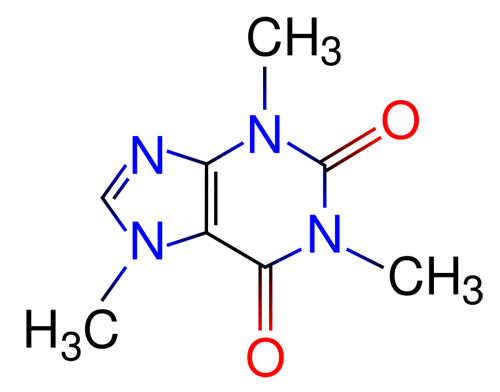
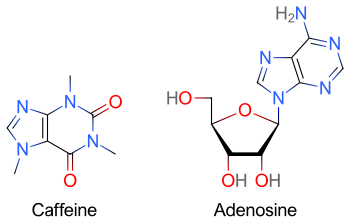
 Caffeine, or, between friends, 3,7-dihydro-1,3,4-trimethyl-1Hpurine-2,6-dione, is a psychoactive drug, meaning that it mainly affects your central nervous system and through that, your brain, altering your behaviour and state of mind. Apart from that ridiculously long IUPAC name, doesn't sound like a whole lot of new information, does it? The interesting bit of information follows: apparently, caffeine is able to do this to our brains, because it is very similar to a chemical that is already present in our bodies: adenosine.

Adenosine accumulates in your brain after long periods of concentration or alertness, and that is interpreted in our brain as a signal to rest or sleep in order to give your poor, hard-worked neurons some time to relax. But no, that really important thing is on tomorrow, you can't afford to lose any time on pesky rest right now! So you go and make yourself a biiiiig cup of coffee, the caffeine molecules swimming around in your cup, and, before long, in your brain, blocking the receptors that usually detect adenosine, keeping you alert and focused for juuust a little bit longer.

Sounds like a pretty sweet deal, doesn't it? Fortunately, too, caffeine doesn't appear to have that many adverse side-effects: though it is claimed to be a diuretic, thereby leading to dehydration, the generally accepted view is that this is not true, and that any such effect caused by caffeine is similar to that of water. Previously, it had also been thought to increase blood pressure, but recent studies have shown no such connection. There's a whole list of risks and benefits of caffeine listed on wikipedia, if you're interested -- I only glanced at the list, but I didn't see anything there that was blatantly contradicted by the rest of my research; still, take it with a grain of salt. I guess the fact that it appears relatively harmless makes sense: I wouldn't think that anything ultimately harmful to humans could be used as widely as caffeine is, what with the knowledge we have of biochemistry today.

So, the only thing you really have to worry about in your reckless coffee consumption is addiction. Like any other drug, caffeine is addictive, and, when used extensively will eventually cause withdrawal symptoms like headaches, muscle pain, irritation, and so on and so forth. One site I visited also claimed that caffeine consumption can turn into a vicious cycle: though its effects diminish over time, as with alcohol, there will be a measure left in your body, and that might disrupt your deep sleep pattern, leading to restless sleep, which, then, leads to more excessive caffeine intake.

That's all I've got for now, folks! Hope none of you get caught in the vicious caffeine cycle in the vicious month that is called November (I know I'm about six days off the start of November, but it's appropriate, ok?); and if you are, well, at least it's delicious, delicious coffee, right?


Sources:
http://www.overcaffeinated.org/
http://www.rsc.org/chemistryworld/podcast/CIIEcompounds/transcripts/caffeine.asp?playpodcastlinkuri=%2Fchemistryworld%2Fpodcast%2FCIIEcompound.asp%3Fcompound%3DCaffeine
http://en.wikipedia.org/wiki/Caffeine
I also mercilessly stole the pictures off google images. If you own any of these images and would like them removed, please notify me in a comment, and I will take them down.